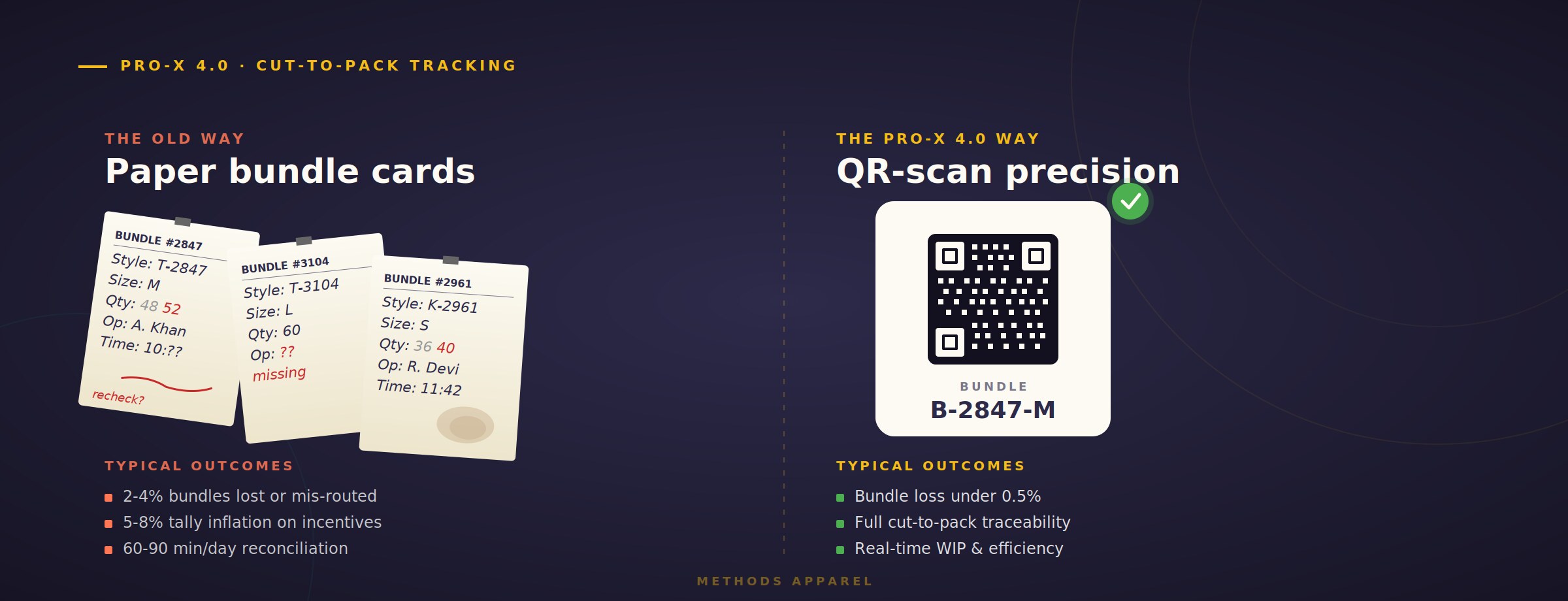
Walk into any apparel factory in India, Bangladesh, or Sri Lanka and follow a single bundle from cutting to packing. You will see it pass through 12 to 15 different hands. At each station, someone makes an entry — on a paper card stapled to the bundle, in a tally register, on a clipboard hanging next to the machine.
Multiply that by 3,000 bundles a day in a mid-sized factory, across 30 styles a month. That is roughly 500,000 manual entries every month — every one of which can be late, wrong, missed, or invented.
Most factories accept this as the cost of doing business. They've always tracked bundles on paper. The system works "well enough." The supervisor has a feel for the line. The reports come in by Monday.
In our 40+ years across apparel factories, we have measured what this paper-based "good enough" actually costs. The number is consistently higher than factory owners expect — and it grows every year as buyers demand more visibility, tighter delivery windows, and faster reaction to floor issues.
What "Bundle Tracking on Paper" Actually Looks Like
The phrase sounds simple. The reality is anything but. Bundle tracking on paper means:
Every one of those steps introduces a delay between what is happening on the floor and what management knows about it. By the time the Monday production report lands on the factory manager's desk, it is a snapshot of last week — corrected, smoothed, and full of small reconciliation errors no one will ever question.
The factory does not run on the floor reality. It runs on a delayed, hand-cleaned approximation of it.
The Six Hidden Costs of Paper-Based Bundle Tracking
When we audit factories considering a move to digital tracking, we look for six specific cost channels. Each one is invisible on the P&L but adds up to real money every year.
| Hidden Cost | What's Actually Happening | Typical Annual Impact |
|---|---|---|
| Bundle Loss & Mis-routing | 2-4% of bundles go to wrong line, get re-cut, or get lost between sections | USD 80K – 150K in re-work and replacement fabric |
| Operator Tally Inflation | Hand-written tallies routinely overstate output by 5-8% | USD 60K – 110K in incentive overpayments |
| Delayed WIP Visibility | Bottlenecks discovered hours late; supervisor reaction always reactive | USD 100K – 200K in lost line efficiency |
| Reconciliation Labour | Floor supervisors spend 60–90 mins/day reconciling tally sheets | USD 40K – 70K in supervisor time |
| Buyer Audit Failures | No traceability from cut to packed; buyer compliance scores drop | Hard to quantify, often largest |
| Decision Delay | Management acts on Monday data instead of real-time signals | Compounding loss across every order |
For a USD 30M factory, the conservative total sits in the range of USD 280,000 – 530,000 per year. For a USD 100M operation, you can scale linearly. Most factory owners are surprised by the second number, because nobody has ever added them up.
Paper bundle tracking does not feel expensive because the cost is distributed across thirty different micro-leaks — none of them big enough to investigate, all of them too big to ignore in aggregate.
Why the Old System Worked — and Why It Doesn't Anymore
Paper-based bundle tracking is not stupid. It evolved for good reasons. In a factory of 200 machines making 8 styles a season for one or two long-standing buyers, paper was sufficient. The supervisor knew every operator. The merchant knew every order. Information moved through human conversation faster than it could move through any system.
That world is gone. Today's apparel factory is:
The old paper system was built for an old industry. The new industry generates too much data, too fast, across too many concurrent streams, for paper to keep up. What used to be efficiency is now bottleneck.
What QR-Based Bundle Tracking Actually Replaces
A digital bundle tracking system — Pro-X 4.0 is built around QR codes printed at cutting — does not just digitise the paper cards. It replaces the entire downstream chain:
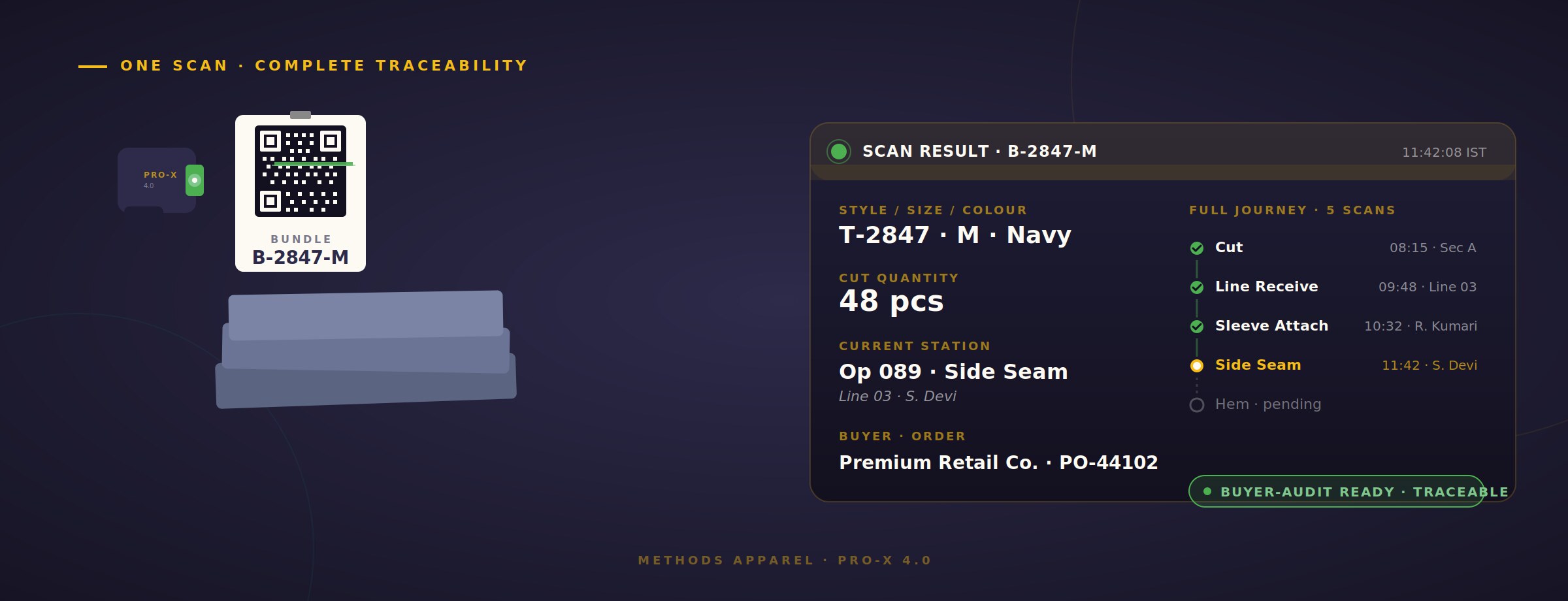
The bundle card becomes a QR sticker. Printed automatically when the bundle is cut. Contains style, size, colour, cut quantity, line assignment — and a unique ID that links to a digital record.
Manual tally entries become scans. Operator scans bundle at start, scans at end. Quantity, time, and operator identity recorded automatically. Zero handwriting, zero ambiguity.
Hourly board updates become live dashboards. Supervisors and management see real-time WIP, efficiency, and bottlenecks on any device — phone, tablet, floor display.
Monday reports become Friday afternoon decisions. If a bundle is missing or delayed, the system flags it within minutes. If a line is bottlenecked, the supervisor knows before lunch — not after the shift ends.
What Changes in the First 90 Days
Factories that move from paper to QR-based tracking — with the discipline to actually use the system, not just install it — typically report a consistent set of changes within the first quarter.
| Before | After QR-Based Tracking |
|---|---|
| Bundle loss rate 2-4% | Drops to under 0.5% within 60 days |
| Operator tally inflation 5-8% | Eliminated — scans are objective |
| WIP visibility: end-of-shift | Real-time, refreshed every 60 seconds |
| Supervisor reconciliation: 60-90 mins/day | Under 10 minutes; mostly exception review |
| Buyer audit traceability: partial | Full cut-to-pack traceability per garment |
| Management acts on Monday data | Decisions in hours, not days |
The total recovered cost — bundle loss reduction + tally accuracy + supervisor time + faster decisions — typically lands in the USD 180,000 – 380,000 range for a USD 30M factory in year one, which is roughly 60-70% of the original hidden cost. The remainder shows up in years two and three as the data accumulates and management capability builds around it.
The factories that get the most from QR-based tracking are not the ones with the largest budgets — they are the ones whose management adapts to live data instead of just consuming it. Technology is the enabler. Culture is the multiplier.
The Strategic Cost Most Owners Miss
The biggest cost of paper-based tracking is not on the P&L. It is on the future.
Every major buyer — Zara, H&M, Marks & Spencer, Target, Walmart, Levi's — is moving toward sourcing partners who can provide real-time order visibility, full traceability, and digital quality records. Factories that cannot provide this are increasingly being pushed to lower-tier programs, lower-margin orders, or off the approved supplier list entirely.
Paper-tracked factories will still get business. They will just get the business nobody else wants. Real-time-tracked factories will compete for the strategic, high-margin, long-term programs that define a factory's next five years.
How Pro-X 4.0 Delivers This
Pro-X 4.0, our flagship cut-to-pack production tracking system, was built specifically to operationalise this shift for apparel factories. It generates QR-coded bundle stickers at cutting, captures real-time scans at every floor station, integrates with Pro-SMV for accurate operator targets, feeds live dashboards to supervisors and management, and produces full per-garment traceability for buyer audits.
The system is deployed in factories across India, Bangladesh, and Sri Lanka — from 200-machine units to 3,000-machine groups. It works alongside your existing IE, costing, and merchandising teams without replacing them. It just gives them data they can actually act on, in time to matter.