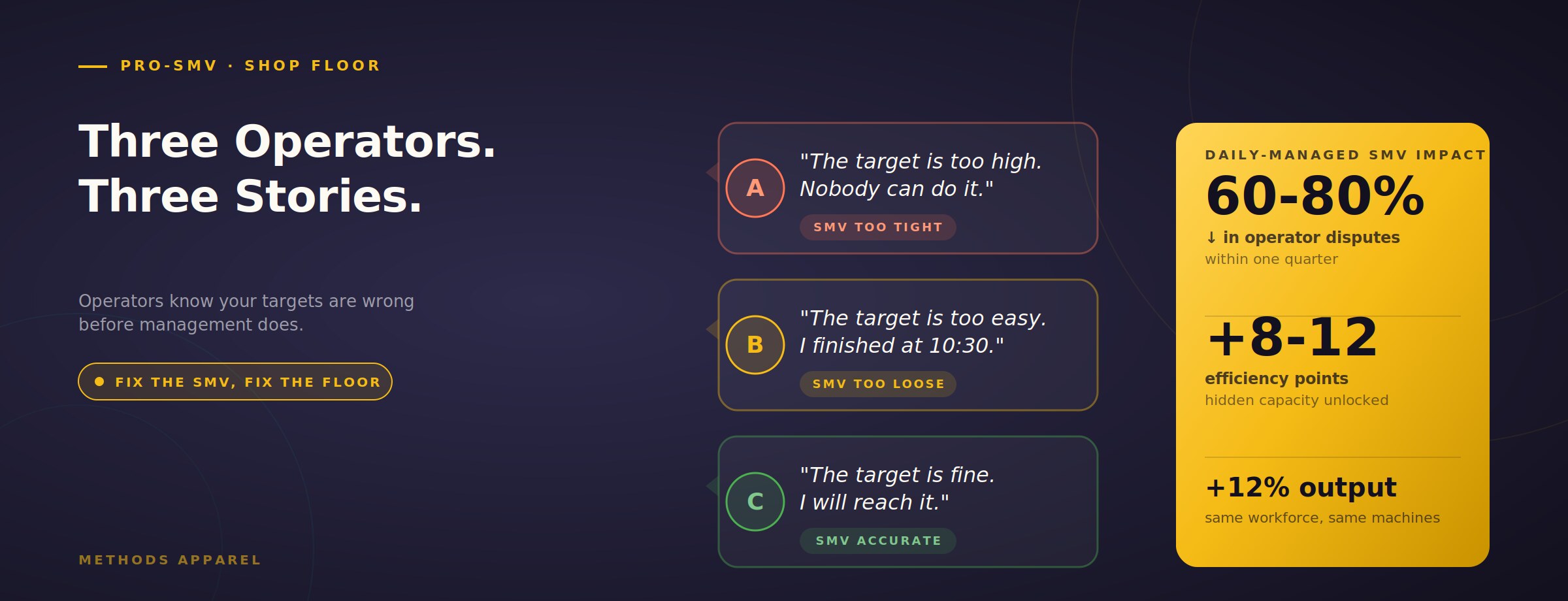
Walk onto any garment production floor at 11 a.m. and ask a sewing operator how she feels about today's target. You will hear one of three answers — and only one of them is the right one.
Some operators will say "the target is fine, I will reach it." Some will say "the target is too high, nobody can do it." And the most revealing answer of all: "the target is too easy — I already finished my bundle at 10:30."
If your floor has all three of these answers happening at once — and most floors do — your operator targets are structurally broken. Not because the supervisors are bad. Not because the operators are difficult. But because the SMVs underneath those targets do not reflect what is actually happening on the floor.
In our 40+ years training supervisors and IEs across India and South Asia, we have seen the same operator-target conflict play out in factory after factory. This article unpacks why it keeps happening — and what it takes to fix it.
The Three Stories Operators Tell
The three answers above are not random. Each one corresponds to a specific kind of SMV problem on your floor.
| What the Operator Says | What's Actually Happening | What the SMV Looks Like |
|---|---|---|
| "The target is too high" | SMV is too tight — operator working hard, still missing | Studied on a fast operator, no fatigue allowance, day-1 method |
| "The target is too easy" | SMV is too loose — operator finishing early, hiding capacity | Studied on a slow operator, generous allowances, before method improvement |
| "The target keeps changing" | SMV revised mid-order without explanation | Updated but with no audit trail or operator communication |
| "The target is fine" | SMV is accurate and the operator trusts the number | Currently studied, properly rated, with documented allowances |
If 70% of your floor is in the "fine" row, your IE process is working. If most of your floor is in the other three rows, you don't have an operator problem — you have an SMV problem expressing itself as an operator problem.
Why Operators Always Know First
Management often discovers wrong targets through end-of-month efficiency reports. Operators discover wrong targets within the first hour of running the new style.
This is not management failing — it is the nature of measurement. The operator feels every motion, every reach, every difficult panel. She can tell within 20 minutes whether the bundle is taking longer than expected, whether the machine is fighting her, whether the cut pieces are inconsistent. She has the most accurate information about the operation, and she has it first.
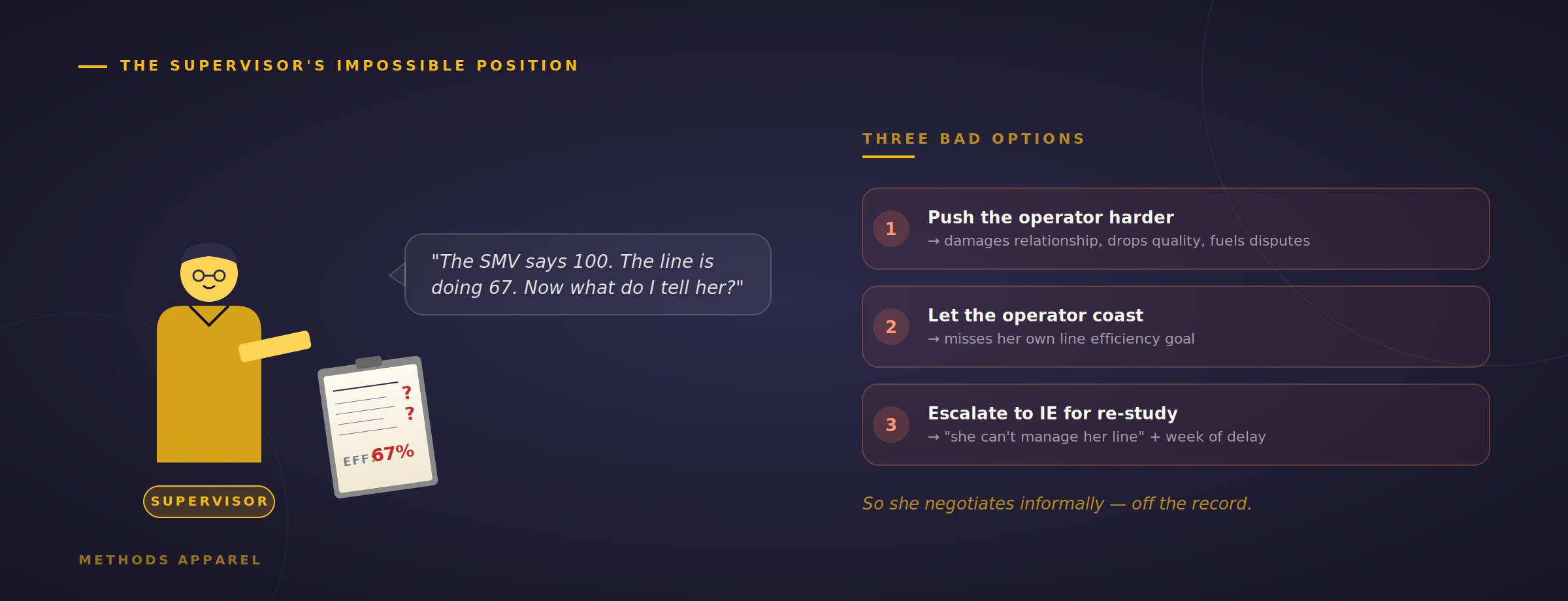
By the time the supervisor's hourly board update shows efficiency at 67%, the operator has already known for three hours that the target is wrong. The question is not whether she knows. The question is whether anyone is listening to her.
How Wrong Targets Erode the Floor — Slowly
A single wrong target on a single day is recoverable. The damage compounds over weeks and months in ways that are hard to undo.
Operators slow down to "fit" the target. When SMVs are loose, the natural human response is to pace yourself to finish exactly at the target. The operator who could have done 120% holds back to 105% — because anything higher will trigger an SMV revision next week. Capacity disappears quietly.
Quality drops as operators rush to hit numbers. When SMVs are tight, the opposite happens. Operators skip checking, skip re-positioning, skip the second pass. The quality control reject rate climbs. The factory pays in re-work — but the cost is attributed to "carelessness," never to wrong SMV.
Trust between operator and supervisor erodes. Every conversation about "why didn't you hit the target?" becomes a confrontation when the operator knows the number was wrong. Supervisors stop confronting because they sense the unfairness. Operators stop trying because they sense the indifference. Both sides give up on the target as a meaningful measure.
High performers leave; low performers stay. Skilled operators who consistently outperform have two choices when SMVs are loose: hide their capacity, or move to a factory where their performance is recognised. The best operators leave first. The factory ends up over-staffed with average performers and wonders why productivity is declining.
The Supervisor's Impossible Position
Floor supervisors are caught in the middle of this. They are accountable for line efficiency targets that depend on accurate SMVs they did not set. When the SMV is wrong, the supervisor has only bad options.
If she pushes the operator to hit a too-tight target, she damages the relationship and the quality. If she lets the operator coast on a too-loose target, she fails her own efficiency goal. If she escalates to IE for a re-study, she signals "I cannot manage my line" — and the re-study takes a week to happen anyway. Most supervisors end up quietly negotiating informal targets with each operator, off-the-record, which works until the next style starts and the cycle begins again.
Why Yearly or Style-Wise SMV Setting Cannot Fix This
Most factories revise SMVs at the start of each new style. This is better than never revising, but it is not enough. Within the first week of a new style:
The result: the SMV in your spreadsheet is correct for the moment it was studied, and progressively less correct every day afterwards. By Friday, the gap between target and reality has reopened — and the operator conflict starts again.
The fix is not to do more studies. The fix is to manage SMV as a living number — one that updates when conditions change, with audit trails operators can trust, and with mechanisms that catch drift before it becomes a dispute.
What Accurate Daily SMVs Actually Change
Factories that move to daily-managed SMV systems report the same set of changes on the floor — usually within one to two seasons.
| Before | After Daily SMV Management |
|---|---|
| "The target is wrong" arguments daily | Operators trust the number; arguments shift to method improvement |
| Hidden capacity (operators holding back) | Real capacity visible — overall efficiency 6–11% higher |
| Inconsistent incentive payouts | Fair, predictable incentive scheme — operator satisfaction up |
| Supervisor-IE finger-pointing | Drift alerts trigger re-studies automatically — no escalation needed |
| Quality reject rate spikes on tight SMVs | Rates stabilise; quality and target align rather than conflict |
The change is not just operational — it is cultural. When operators stop arguing about whether the target is fair and start engaging with how to beat it, the entire conversation on the floor shifts from confrontation to improvement.
What This Looks Like in Practice
A daily-managed SMV system does not mean re-studying every operation every day. That would be impossible. It means three specific changes to how SMV operates on your floor.
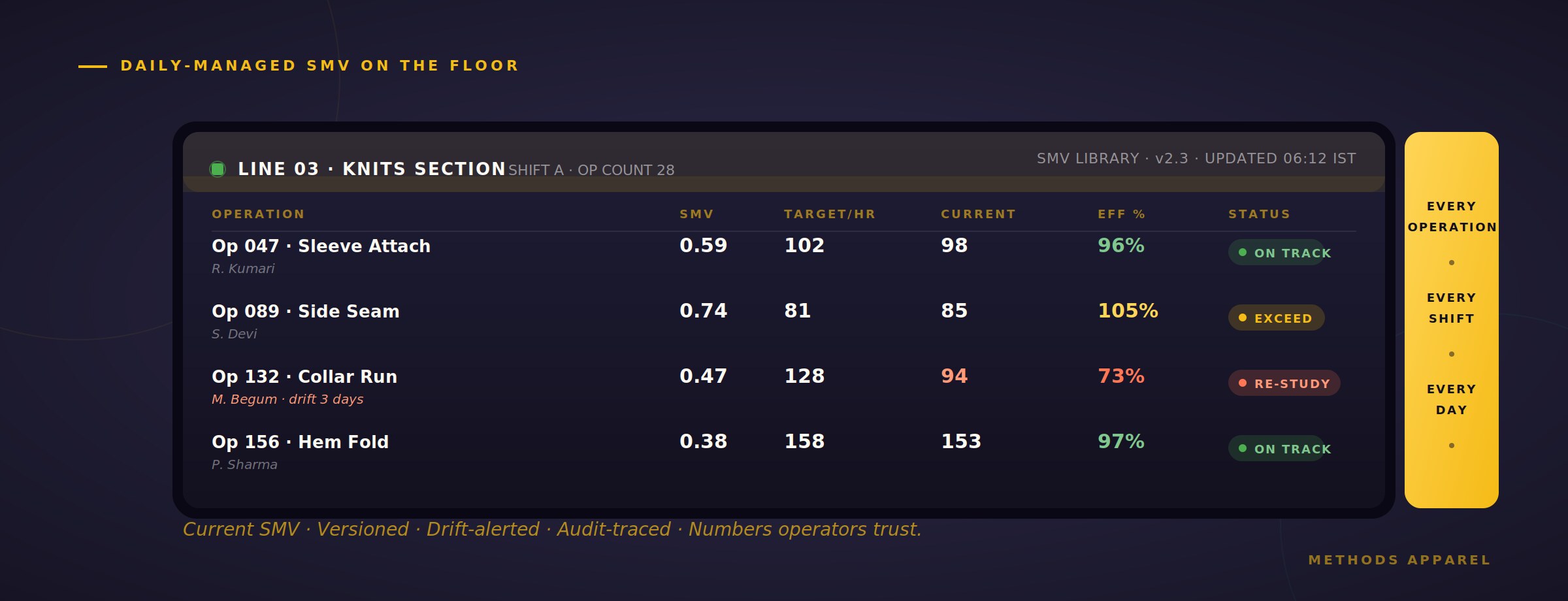
First, every operation has a current, defensible SMV — pulled from a versioned library, with the date studied, the rating, the allowances, and the operator studied all recorded. When an operator questions a target, the supervisor can show why the SMV is what it is, with full transparency. Arguments stop being "you don't understand my work" and become "let's look at the data together."
Second, efficiency drift is monitored automatically. When the operators on a specific operation are running at 75% for three consecutive days — or at 130% — the system flags the operation for re-study. The IE does not have to discover the problem from a monthly report. The data tells her where to look.
Third, when SMV changes, the change is communicated and documented. The operator knows why the SMV moved, when, and on what basis. There is no surprise revision on Tuesday morning. There is no informal off-the-record negotiation. The floor operates on numbers everyone trusts.
The Hidden Productivity in Trusted Targets
The biggest gain from accurate daily SMVs is not the dispute reduction — though that alone justifies the investment. The biggest gain is the productivity that emerges when operators stop holding back.
On a typical line with 25–30 operators, the gap between what operators can produce and what they do produce — when SMVs are loose — is often 8–12 percentage points of line efficiency. That is hidden capacity sitting on your floor every day, costing nothing to unlock except trust in the number.
On a 1,000-machine factory running at 65% efficiency, lifting that to 73% through accurate daily SMVs is roughly 12% more output from the same workforce. No new hires. No new machines. No new training. Just numbers that operators believe in.
How Pro-SMV Operationalises This
Pro-SMV, our flagship standard time management software, is designed to make daily SMV management practical at factory scale. It maintains a versioned SMV library across styles and operations, enforces consistent rating and allowance discipline, integrates with floor-tracking data so drift is detected automatically, and produces audit-traced SMV records that operators and supervisors can both review.
But the technology is only the enabler. The real change is in how supervisors and operators talk about targets — from "is this fair?" to "is this current?" That shift, supported by the right tooling, is what makes the difference between a floor that argues and a floor that improves.