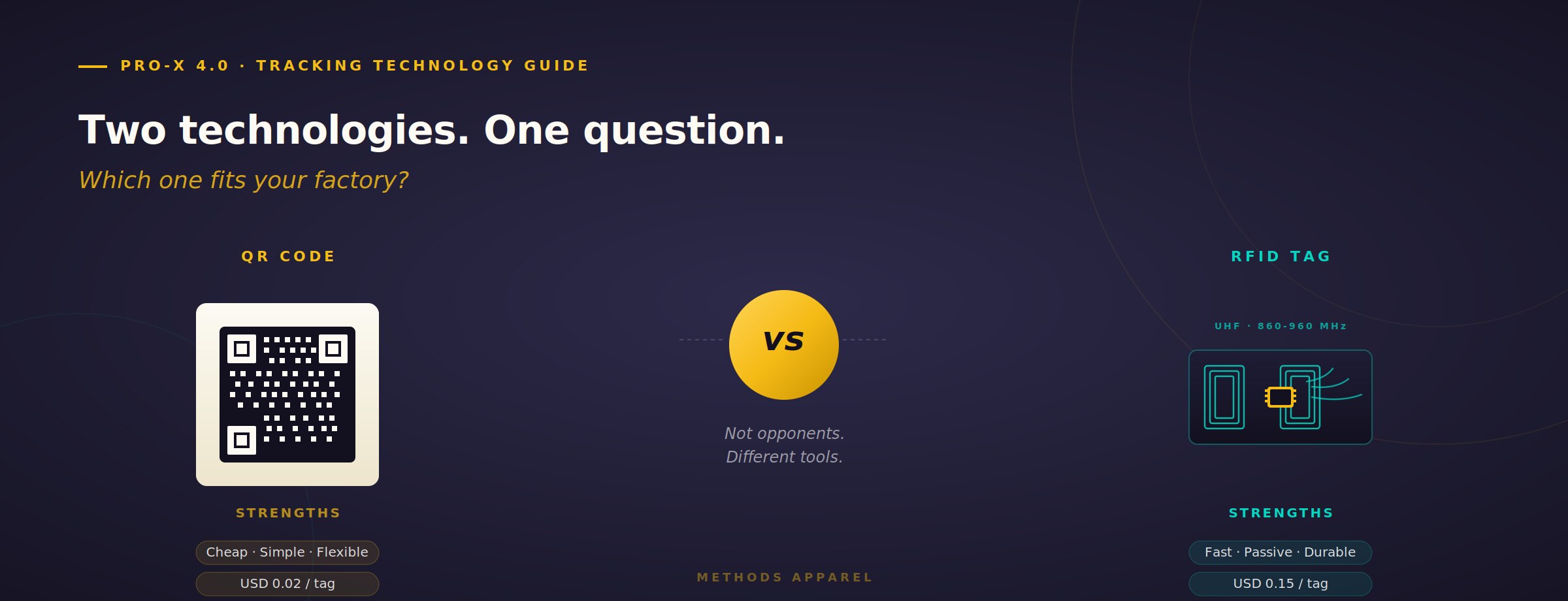
Every apparel factory evaluating a move away from paper tracking eventually asks the same question: QR code or RFID?
And they usually get the same unhelpful answer from vendors: "our solution is the best solution." QR vendors explain why QR is better. RFID vendors explain why RFID is better. The factory owner walks away with two glossy brochures and no clarity.
The honest answer is more nuanced. Both technologies work. Both have specific strengths. Neither is universally superior. And for apparel factories specifically, the choice is not close — but the reasoning matters, because it also tells you when the other answer might be right.
In our 40+ years across factories in India, Bangladesh, and Sri Lanka — including deployments of both QR and RFID at various points — we have watched this decision play out enough times to be direct about it. This article is the practical guide we wish factory owners had when they first started asking the question.
What Each Technology Actually Is
Before comparing, it helps to be precise about what we are comparing.
QR code (Quick Response code) is a 2D barcode printed on a sticker, tag, or garment label. It contains a unique identifier that links to a database record. Reading requires a scanner — a handheld device, a phone camera, or a fixed reader — pointed at the code from close range with clear line of sight. Every scan is a deliberate action by an operator.
RFID (Radio-Frequency Identification) uses a small chip and antenna embedded in a tag. When the tag passes near an RFID reader, the reader energises the tag wirelessly and receives the tag's unique ID. No line of sight needed. No scanning action needed. Tags can be read from centimetres away (HF/NFC) or several meters away (UHF), depending on the technology.
The Head-to-Head Comparison
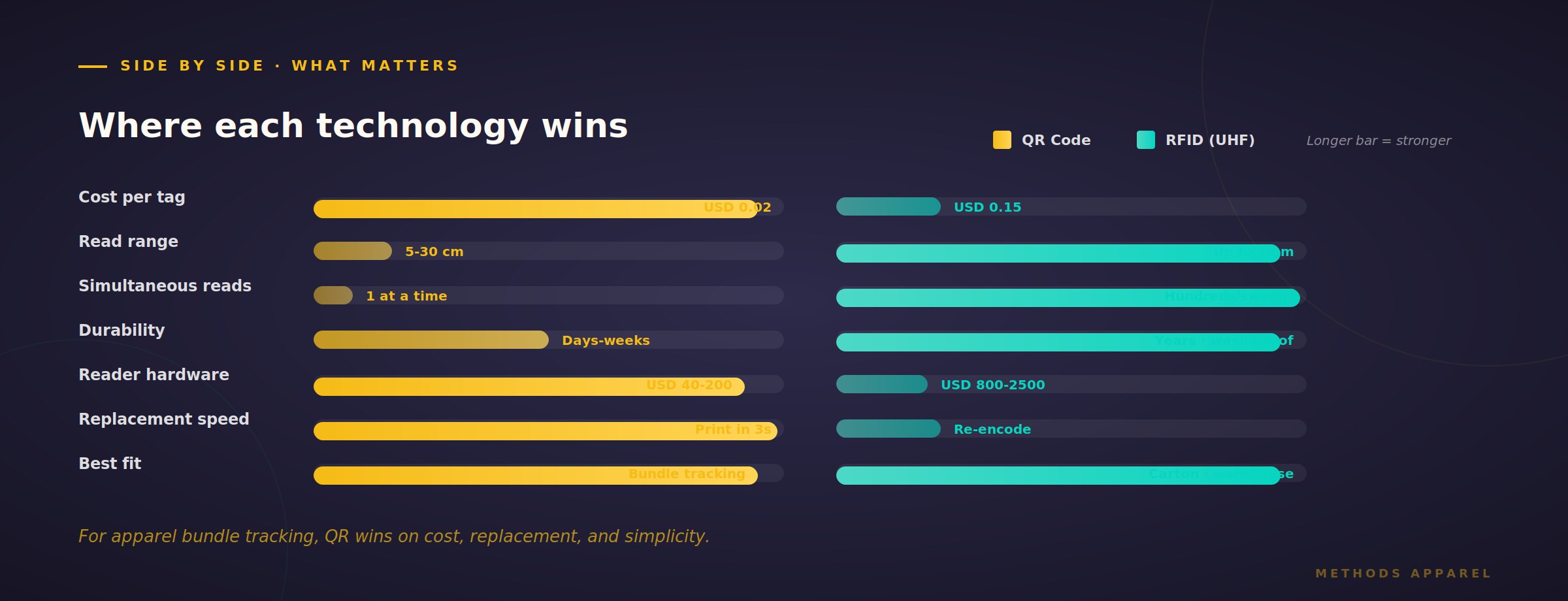
For an apparel factory tracking bundles from cut to pack, here is how the two technologies compare on the dimensions that actually matter.
| Dimension | QR Code | RFID (UHF) |
|---|---|---|
| Cost per tag | USD 0.01 – 0.03 (printed sticker) | USD 0.08 – 0.35 (chip + antenna) |
| Reader infrastructure | USD 40 – 200 per handheld scanner | USD 800 – 2,500 per UHF reader |
| Read range | Line-of-sight, 5–30 cm | Up to 6–10 metres, no line of sight |
| Simultaneous reads | One at a time | Hundreds of tags in one sweep |
| Scan action | Deliberate — operator points and shoots | Passive — auto-detected on movement |
| Durability (fabric setting) | Good if laminated; ink can smudge with sweat | Excellent — survives wash cycles |
| Metal / liquid interference | None | Significant — needs specific tag types |
| Reprint / replacement | Trivial — print on demand | Harder — tags need re-encoding |
| Failure recovery | Print a new sticker in 3 seconds | Get a new tag, re-encode, re-attach |
| Operator training | Minimal — anyone can scan | Minimal at operator, significant at admin |
Neither column is uniformly better. QR is cheaper, simpler, easier to fix. RFID is faster, more automated, more durable. The right question is not "which is better" — it is "which advantages matter for what I actually do?"
Where RFID Genuinely Wins
Any honest comparison has to start by acknowledging where the other technology is clearly the right answer. RFID is superior in these scenarios:
High-value, individual-item tracking. Retail stores selling USD 200+ garments have moved to RFID for inventory management, loss prevention, and buyer traceability. The tag cost is trivial against the item cost, and passive reading enables inventory scans of a full store in minutes.
Warehouse pallet or carton movement. When a forklift moves a pallet past a gate reader, RFID captures all cartons on the pallet simultaneously without any operator action. No QR system can match this for bulk logistics.
Harsh-environment tracking. Laundry facilities that need to track individual garments through wash-dry-fold cycles use RFID because printed QR codes cannot survive repeated commercial washing.
Sub-second cycle time requirements. When items move faster than a human can scan, RFID is the only option. A conveyor belt moving 3 cartons per second cannot be tracked with QR scanning.
RFID's real advantage is volume and speed at the same time. When you need to read many tags in one sweep, or when the item moves too fast for a human scan, RFID is not just better — it is the only option that works.
Where QR Wins for Apparel Factory Tracking
Inside an apparel factory — bundle-level cut-to-pack tracking, which is what Pro-X 4.0 is designed for — the picture inverts. QR wins on almost every dimension that matters. The reasons are structural, not preferential.
Bundle-level tracking is inherently sequential. An operator picks up one bundle, works on it, moves to the next. There is no scenario where 50 bundles need to be read simultaneously in a sewing line context. RFID's biggest advantage — bulk simultaneous reads — has no use case at the bundle level.
The tag lives for one order, then dies. A bundle tag exists from cut to pack — 3 to 15 days depending on the style. It never gets washed. It never gets exposed to weather. It gets thrown away when the bundle is finished. There is no durability requirement that justifies the higher tag cost.
The cost math is decisive at scale. A mid-size factory produces 30,000 – 60,000 bundles a month. At USD 0.02 per QR sticker, that is USD 720 – 1,440 monthly. At USD 0.15 per RFID tag, that is USD 5,400 – 10,800 monthly. Across a year: USD 55,000 – 110,000 in tag cost difference alone, for the same tracking outcome.
Failure recovery is a daily reality. Tags get lost. Get torn. Get soiled. In a QR system, a supervisor prints a replacement in three seconds. In an RFID system, the replacement requires a fresh tag, a re-encoding step, and re-linking to the bundle in the database. On a floor doing 3,000 bundles a day, that difference compounds fast.
The factory already has printers. Every apparel factory has thermal or inkjet printers already in place for size labels, cut tickets, and shipping documentation. Adding QR sticker printing requires almost no new hardware. RFID requires new readers, new encoding stations, and new infrastructure throughout the floor.
The 6-Question Decision Framework
Instead of asking "QR or RFID", ask these six questions about your factory. The answers tell you which system to choose.
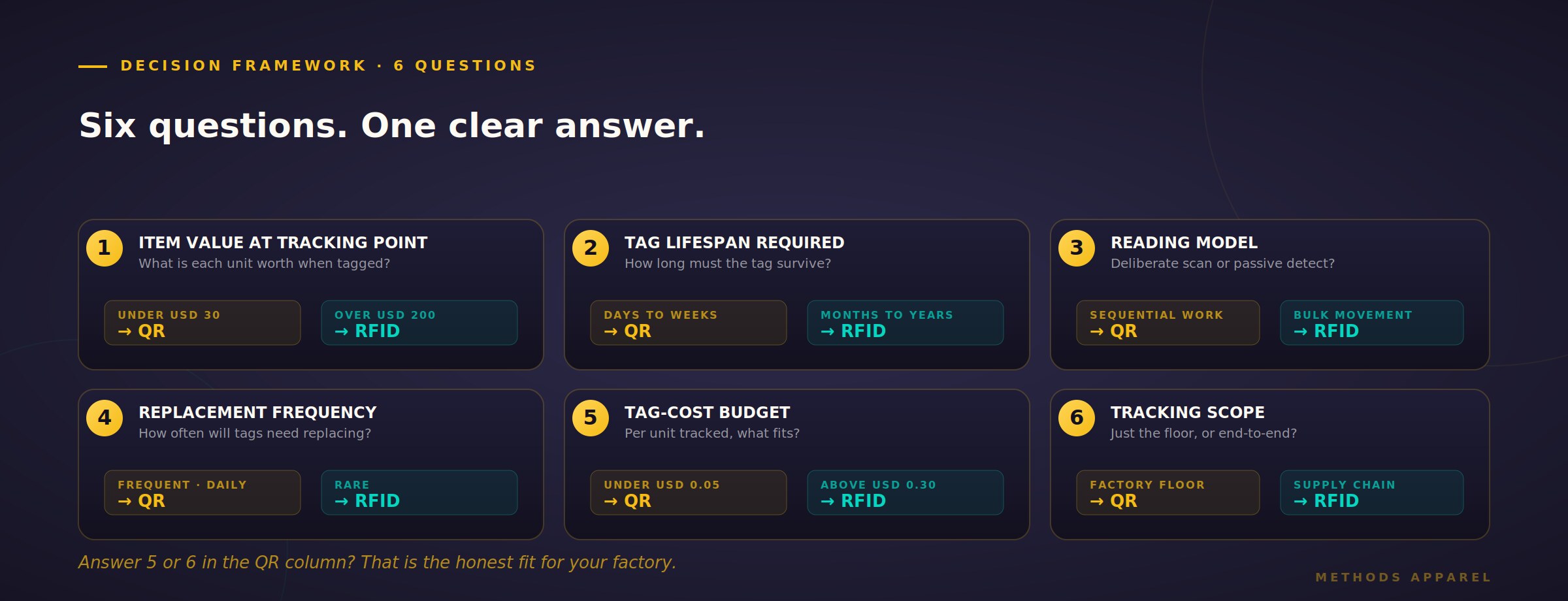
1. What is the item's value at the tracking point? Under USD 30 per unit → QR is fine. Over USD 200 per unit → RFID pays for itself.
2. How long does the tag need to survive? Days to weeks → QR. Months to years → RFID.
3. Is scanning a deliberate action or should it be passive? Sequential, one-at-a-time work → QR. Bulk movement past a fixed point → RFID.
4. How often will tags need replacement? Frequent (daily) → QR (easier recovery). Rare → RFID.
5. What is the tag-cost budget per unit tracked? Under USD 0.05 per unit → QR is the only viable option. Above USD 0.30 → RFID is affordable.
6. Do you need cross-facility or in-transit tracking? Factory floor only → QR. End-to-end supply chain visibility → RFID has real advantages.
For most apparel factories, the answers land squarely in the QR column on 5 or 6 of these questions. That is the honest answer — not a marketing preference, a structural fit.
The Hybrid Case (Where Both Have a Role)
A pattern we increasingly see in mature factories is QR at bundle level, RFID at carton level. QR handles the cut-to-pack tracking inside the factory (where its advantages dominate). RFID handles the finished-carton movement from packing to shipping and into buyer distribution centres (where its advantages dominate).
This is not a compromise — it is a correct application of both technologies to the problems each is best at solving. Some large groups running Pro-X 4.0 have added RFID at the carton stage specifically for buyer-mandated supply chain visibility, while keeping QR everywhere else.
The right question is not "which technology wins?" It is "which technology fits this specific step in the workflow?" Different tools for different problems.
What Buyers Are Actually Asking For
A common misconception among factory owners is that "RFID is what buyers want." This is partially true and mostly outdated.
Buyers want data, not a specific technology. They want to know: where is my order, when will it ship, who made it, was quality checked at every step, and can you trace this specific garment back through the process. QR-based systems deliver every one of these data points as fully as RFID-based systems do — often more granularly, because bundle-level QR tracking captures per-operation data that carton-level RFID does not.
Where buyers do specifically request RFID is for in-store inventory and loss prevention — which is downstream of the factory. Factories that comply typically add RFID at the finished-goods stage, keeping QR through the production process.
How Pro-X 4.0 Approaches This
Pro-X 4.0 is designed around QR-based bundle tracking because that is the structurally correct choice for apparel factory operations. It generates QR stickers at cutting, captures scans at every station, feeds real-time dashboards, and produces full per-garment traceability — exactly the data buyers ask for.
For factories with specific downstream requirements — buyer-mandated RFID at carton, in-transit visibility for premium programs — Pro-X 4.0 integrates with RFID at the finishing / packing stage without disrupting the QR-based production flow. You get the cost efficiency and reliability of QR through the factory, and the buyer-mandated RFID capability where it actually adds value.
Our team has 40+ years of operational experience in apparel manufacturing and has evaluated both technologies extensively across live deployments. The answer for most factories is not one or the other — it is the right technology at the right stage of the workflow.