Every apparel factory in South Asia has a version of the same morning ritual. The IE team hands the line supervisor a fresh operation bulletin. The supervisor looks at it, looks at the operators available, and spends the next 40-90 minutes distributing operations across the line. Some by SMV. Some by "which operator is good at what". Most by intuition built over 15-20 years of watching lines run.
And it works. Sort of. The line runs. Output happens. The end-of-day report shows a number that is close enough to plan that nobody investigates further.
Here is what a stopwatch and a station-by-station capacity study reveal: on a typical unbalanced line, 3 to 5 stations sit idle 15-25% of every hour, waiting on 1 or 2 bottleneck stations. If you added up the wasted capacity, you would find the line is producing at 72-78% of what it could — and the supervisor's intuition is the reason, not the solution.
In our 40+ years across apparel factories, we have watched brilliant supervisors do this brilliantly — and watched the mathematics of line balancing quietly beat every one of them, every time. This article is about what changed, and why the industry finally moved on.
Why Gut-Feel Line Balancing Fails at Scale
A senior supervisor balancing a simple line — 8 operators, 12 operations, 1 style — can produce a genuinely good balance in about an hour. Enough experience and enough time can beat the math on small problems.
Then the problem gets real. A modern sewing line runs 32-48 operators, executes 60-90 operations with dozens of dependencies and machine constraints, on a style-mix that changes every 3-5 days. And it needs a new balance every time a style changes, every time an operator is absent, and every time the buyer accelerates a delivery. That is 2-4 rebalances per week on every line.
No human intuition scales to that. The math doesn't care about how it feels. And once the numbers get above about 20 operations, the supervisor stops finding the optimal balance and starts finding a workable one. The gap between those two is what shows up as bottlenecks, idle stations, and 78% line efficiency.
A great supervisor balancing a small line is a work of art. A great supervisor balancing a modern multi-station line is a bottleneck they didn't know they were.
The Math Nobody Wanted to Do
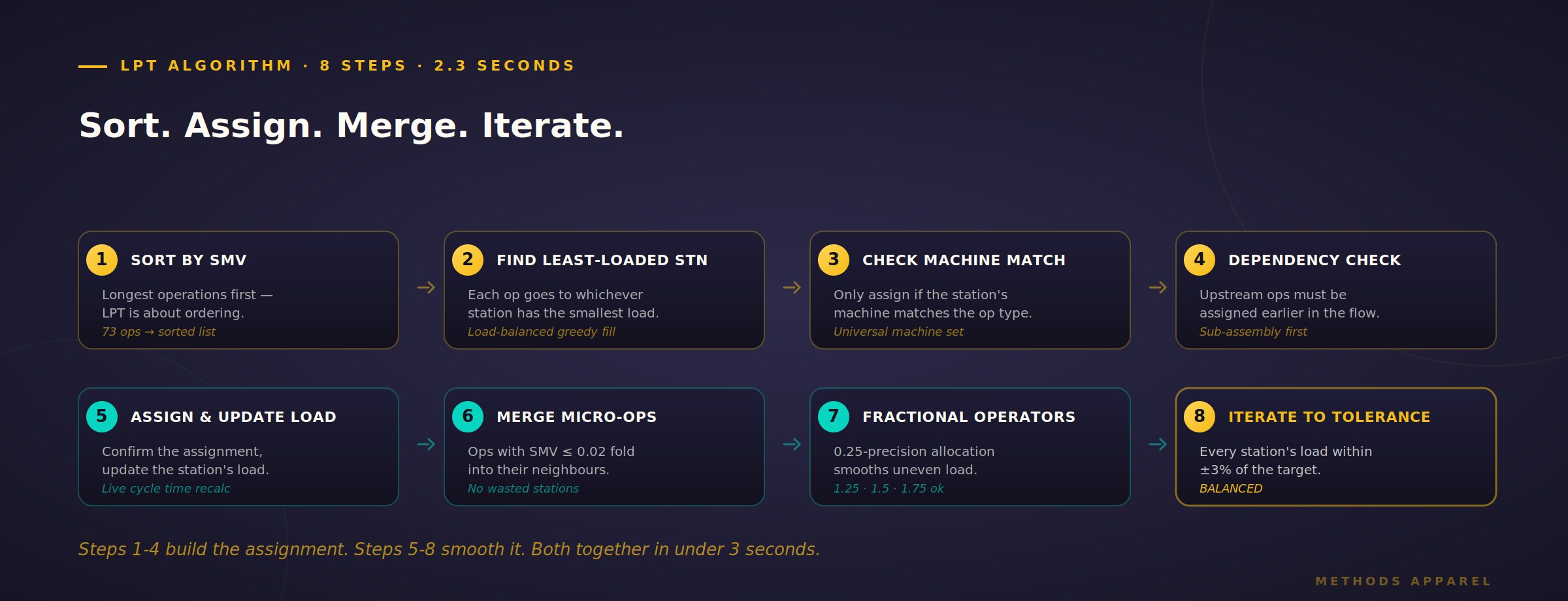
Line balancing is fundamentally a well-studied optimisation problem — computer science calls it the Longest Processing Time (LPT) scheduling problem, and it has been rigorously solved since the 1960s. The algorithm is not new. What is new is that we can now run it in under a second on a laptop, on a fresh operation bulletin, and get a result that a human supervisor cannot produce in an hour.
Here is what the algorithm actually does, in plain language:
What comes out the other end is a balance where every station's cycle time is within a narrow tolerance band of every other station's. No idle waiting. No bottleneck. Every operator has enough work; no operator has too much. Which is the theoretical definition of a balanced line — and, for the first time in the industry's history, one that a computer can produce faster than a supervisor can even review it.
The Difference in Real Numbers
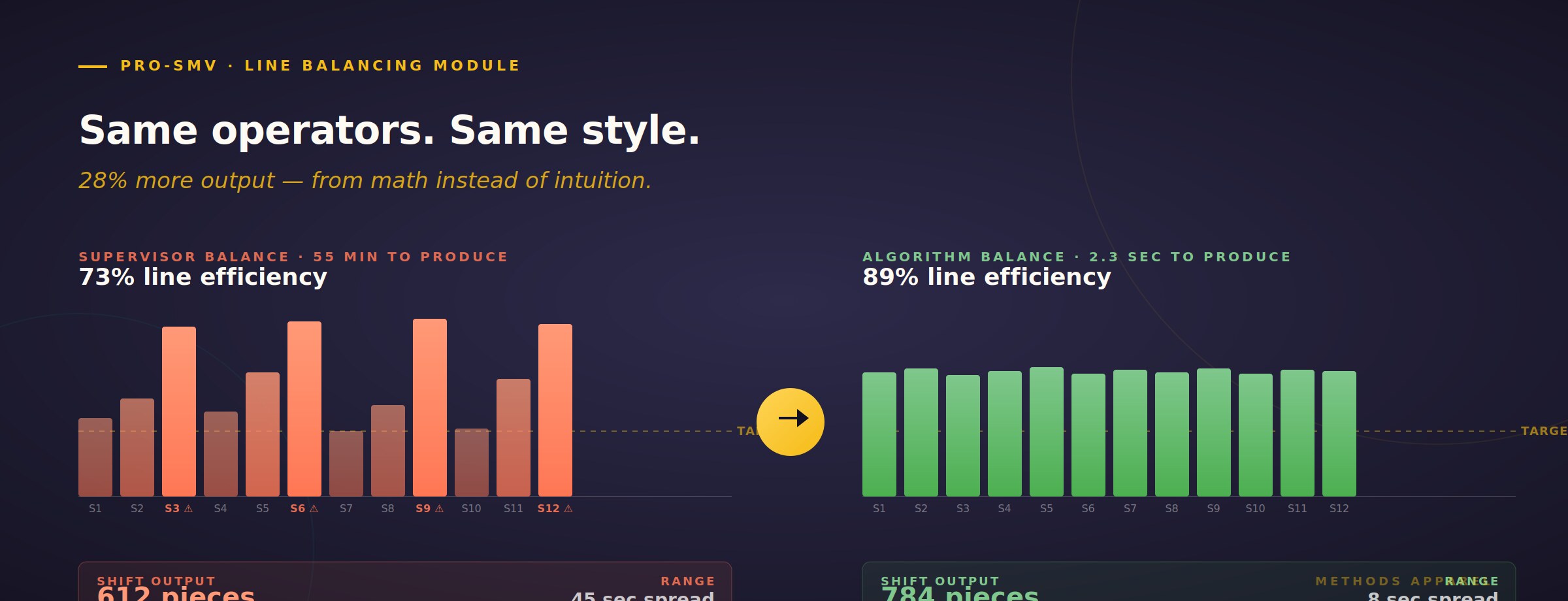
We recently ran a side-by-side comparison on a real client style — a Nordstrom dress with 73 operations, 42 operators, 6 machine types, and a mix of sub-assemblies. The supervisor produced a balance in 55 minutes. The Pro-SMV Line Balancing algorithm produced a balance in 2.3 seconds. Both were then run for a full shift on the same fabric, same operators, same targets.
| Metric | Supervisor Balance | Algorithm Balance |
|---|---|---|
| Bottleneck stations | 4 stations at >110% load | 0 stations at >103% load |
| Idle stations | 5 stations at <80% load | 0 stations at <91% load |
| Station cycle time spread | Range: 45 sec | Range: 8 sec |
| Shift output | 612 pieces | 784 pieces |
| Line efficiency | 73% | 89% |
| Time to balance | 55 minutes (supervisor) | 2.3 seconds |
A 28% output improvement from the same operators, same style, same shift — just from replacing intuition with math. Multiply that across 12 lines running 300 days a year and the arithmetic becomes uncomfortable for anyone still balancing by hand.
What Balanced Actually Looks Like
A properly balanced sewing line has a specific visual signature that anyone who has spent time on floors will recognise instantly. The station cycle times are all within a tight band — you can almost see the rhythm. Bundles flow steadily from station to station with no accumulation. No operator is racing; no operator is waiting.
An unbalanced line looks completely different. There is always one station buried under a bundle pile. Two or three operators watch their neighbours or fidget with their machines. The line supervisor is constantly moving bundles around by hand to compensate. Output is inconsistent hour to hour.
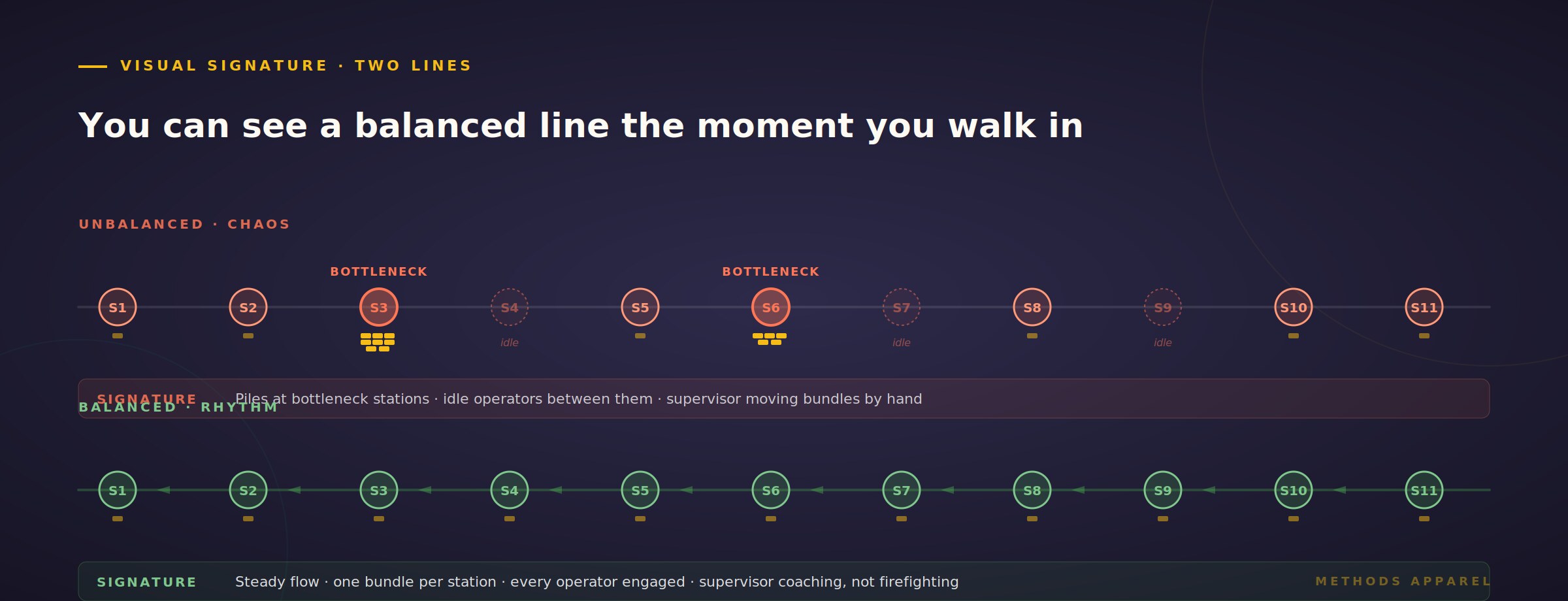
The difference is not effort. Both lines' operators are working just as hard. The difference is that on the balanced line, the work has been distributed to match the operators' capacity. On the unbalanced line, it hasn't.
The Constraints the Algorithm Handles That Humans Miss
A common objection to algorithmic line balancing is that "the algorithm doesn't understand our operators" — the assumption being that human judgment about who can do what will always beat a spreadsheet. This is true in isolation. It is completely false in practice, because the algorithm handles constraints humans systematically forget:
Machine-type compatibility. Operation 47 requires a 4-thread overlock. Only 8 of your 42 operators have that machine in their workstation. The algorithm knows. The supervisor knows too — most of the time. On a bad Monday, they forget.
Skill-level matching. Some operations need experienced operators. The algorithm can be configured to bias skill-appropriate operations to appropriate operators. The supervisor knows this in theory; in practice they allocate by who is available.
Micro-operation merging. Very small operations (SMV ≤ 0.02) should be merged with neighbouring ops rather than allocated their own station. The algorithm does this automatically. Supervisors almost never do it correctly.
Universal machines. Some workstations have flexibility (single-needle can also run zigzag with an attachment change). The algorithm tracks this via a compatibility set and exploits the flexibility when useful. Supervisors either always exploit it (creating chaos) or never exploit it (losing capacity).
Fractional operator allocation. When a station's load is 1.35 operators' worth of work, the algorithm allocates 1.25 operators (0.25 precision) and reallocates the remaining 0.1 as sharing across an adjacent station. Supervisors round to 1 or 2 operators, which is where 40% of the imbalance comes from.
The supervisor does not lose out to the algorithm because the algorithm is smarter. The supervisor loses out because the algorithm consistently applies constraints that supervisors know but forget under time pressure. The math is not the point. The consistency is.
What Changes in 30 Days
Factories that adopt algorithmic line balancing — with the discipline to actually use the output rather than override it into "what the supervisor was going to do anyway" — see a specific pattern in the first month:
| Before | After Algorithmic Balancing |
|---|---|
| Line efficiency 72-78% | 85-92% within 30 days |
| Rebalance takes 45-90 min per line | Rebalance in seconds; review in 5 min |
| 2-4 bottleneck stations per shift | 0-1 per shift; caught in advance |
| Supervisor spends morning at desk | Supervisor spends morning on floor |
| New style takes 2-3 days to stabilise | New style hits target output in 1 day |
The most valuable of these — usually underappreciated by factory owners — is the last one. On a modern buyer schedule where styles change every 4-6 days, a 1-day style stabilisation vs 3-day style stabilisation is worth 30-40% additional productive capacity per line, per season. It is worth more than the direct efficiency improvement.
How Pro-SMV Delivers This
Our Pro-SMV platform includes a Line Balancing module built around the 8-step LPT algorithm described in this article, calibrated across hundreds of real client operation bulletins over the past decade. It takes a fresh OB, the available operator roster, and machine compatibility matrix, and produces a fully balanced line — with fractional operator allocations, micro-op merging, and constraint compliance — in seconds.
What matters more than the algorithm is what surrounds it. The module integrates with the operator database, the machine master, and the style master so it works with your real factory constraints not theoretical ones. It produces output in the format your supervisor already uses so adoption is fast. And it retains the option for manual override on the 5-10% of cases where the supervisor's judgment genuinely does add value.
Factories running the Pro-SMV Line Balancing module in production typically see 10-15 percentage points of line efficiency improvement within 90 days — most of it recovered from bottleneck elimination and micro-operation handling that supervisors never had time to do properly.