Every apparel factory has one. A thick green-cloth ledger or a stack of A4 register pages, kept on a clipboard or in the production manager's drawer. It records everything that happens between cutting and packing — bundle by bundle, line by line, day by day. Some factories call it the production register. Some call it the bundle book. Some just call it "the ledger."
Whatever you call it, it does the same job — and that job is becoming impossible to do well by hand.
The production register was designed for an era when a factory ran 4 styles a season at 2 lines, made one main fabric, and shipped to two long-standing buyers. Today's factories run 30 styles a month across 12 lines, with 8 fabric variations and 10 different buyer specifications. The register has not changed. The workload around it has multiplied by ten.
Across our 40+ years in apparel manufacturing, we have seen this transition happen on factory floor after factory floor: from paper register to QR-coded real-time tracking. This article unpacks what that shift actually looks like — operationally, day by day — and why factories that have made the change are now structurally faster than those that haven't.
What the Production Register Actually Tracks
Before talking about what replaces it, it helps to be precise about what the register is doing today. In a typical factory, the production register captures:
Every one of these data points has consequences. Bundle in/out drives line balancing decisions. Operator-machine assignment drives wage and incentive calculations. Quantity-rejected drives quality reviews. WIP drives delivery planning. Every entry matters — and every entry is written by hand, in pencil or pen, by someone juggling six other tasks at the same time.
The production register is the backbone of factory management. The problem is not that the data is unimportant — it is that the way the data is being captured cannot keep up with how fast modern factories actually move.
What Goes Wrong in Paper-Based Tracking
When we audit factories considering a move to QR-based tracking, the same problems show up — across factory size, country, and product category. Four patterns are nearly universal.
The time lag. Floor entries get reconciled at end of shift, transferred to Excel the next morning, summarised by Monday. Management is always looking at last week's reality. By the time a bottleneck shows up in a report, it has already cost the line three days of output.
The accuracy gap. Hand-written tally figures consistently inflate or deflate against actual output. Operators round up. Supervisors smooth numbers to hit shift targets. The register tells management what management wants to hear — not what the floor actually produced.
The visibility gap. A bundle that goes to the wrong line, or a sub-operation that took 40% longer than SMV, or a quality reject pattern building on Operator 23 — these stay invisible in paper tracking until they surface in a report several days later. Factories spend hours every week trying to reconstruct what happened.
The traceability gap. When a buyer audit asks "show me which operator did the side seam on this specific garment," the answer is typically "we will check the registers and get back to you." Sometimes the answer is found. Sometimes it isn't. Buyer confidence drops either way.
What Cut-to-Pack QR Tracking Replaces
A real-time QR-based production tracking system — like Pro-X 4.0 — does not just digitise the register. It changes what the register fundamentally is. Instead of being a record of what happened (filled in after the fact), it becomes a live mirror of what is happening (updated in seconds, automatically).
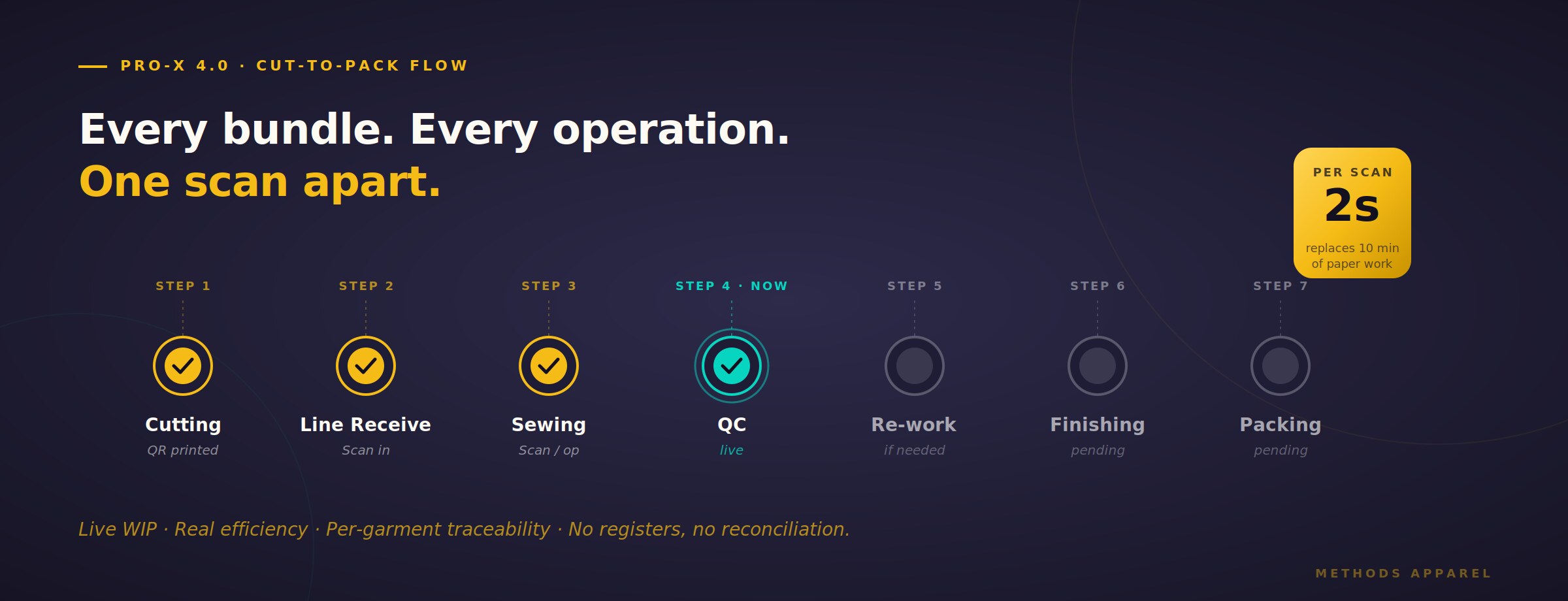
Here is what the cut-to-pack flow looks like in a QR-tracked factory:
| Stage | What Happens | What the System Captures |
|---|---|---|
| 1. Cutting | Bundle is cut. QR sticker printed and attached. | Style, size, colour, cut quantity, cut operator, line assignment, timestamp. |
| 2. Line Receive | Line supervisor scans bundle on arrival. | Receive time, line, operator allocation. |
| 3. Each Operation | Operator scans bundle in, scans out when done. | Start time, end time, operator, station, quantity, any rejects flagged. |
| 4. Quality Check | Bundle scanned at each QC checkpoint. | QC result, defect type if any, re-work flow trigger. |
| 5. Re-work (if needed) | Bundle scanned into re-work flow and back. | Full re-work loop traceability per garment. |
| 6. Finishing | Bundle scanned at trim, press, fold stations. | Finishing operator and time per garment. |
| 7. Packing | Final scan when bundle is packed in cartons. | Carton number, packer, ship date binding. |
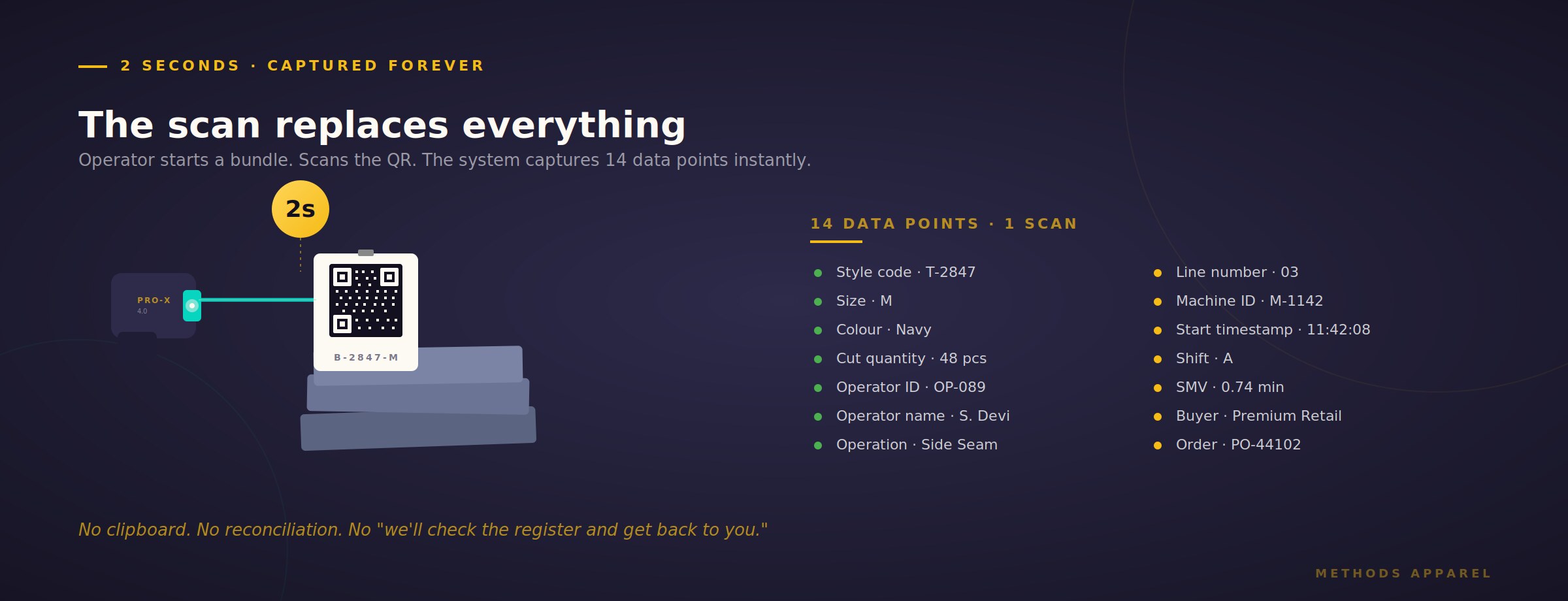
Every scan takes about 2 seconds. The operator does it as part of starting or finishing a bundle — not as an additional task. There is no clipboard, no register, no tally sheet, no end-of-shift reconciliation. The data is already in the system the moment the work is done.
What This Looks Like on the Floor
The most striking thing about walking onto a QR-tracked floor is what is missing. The clipboards are gone. The hourly board updates are gone. The supervisor with the register clamped under one arm is gone. In their place: scanners at each station, a tablet or floor display every few lines, and operators who simply work — without the constant pause to log.
Supervisors no longer spend 60–90 minutes a day reconciling tally sheets. They spend that time on what they should have been doing all along: walking the floor, coaching operators, removing bottlenecks. The system handles the data capture. The supervisor handles the people.
The biggest behavioural shift is not at the operator level. It is at the supervisor level. Once they stop spending half their day on data entry, they discover what their job was always supposed to be.
The Five Things Management Sees That Was Invisible Before
The output side of real-time tracking is what most factory owners get excited about. It is not just faster data — it is fundamentally different data.
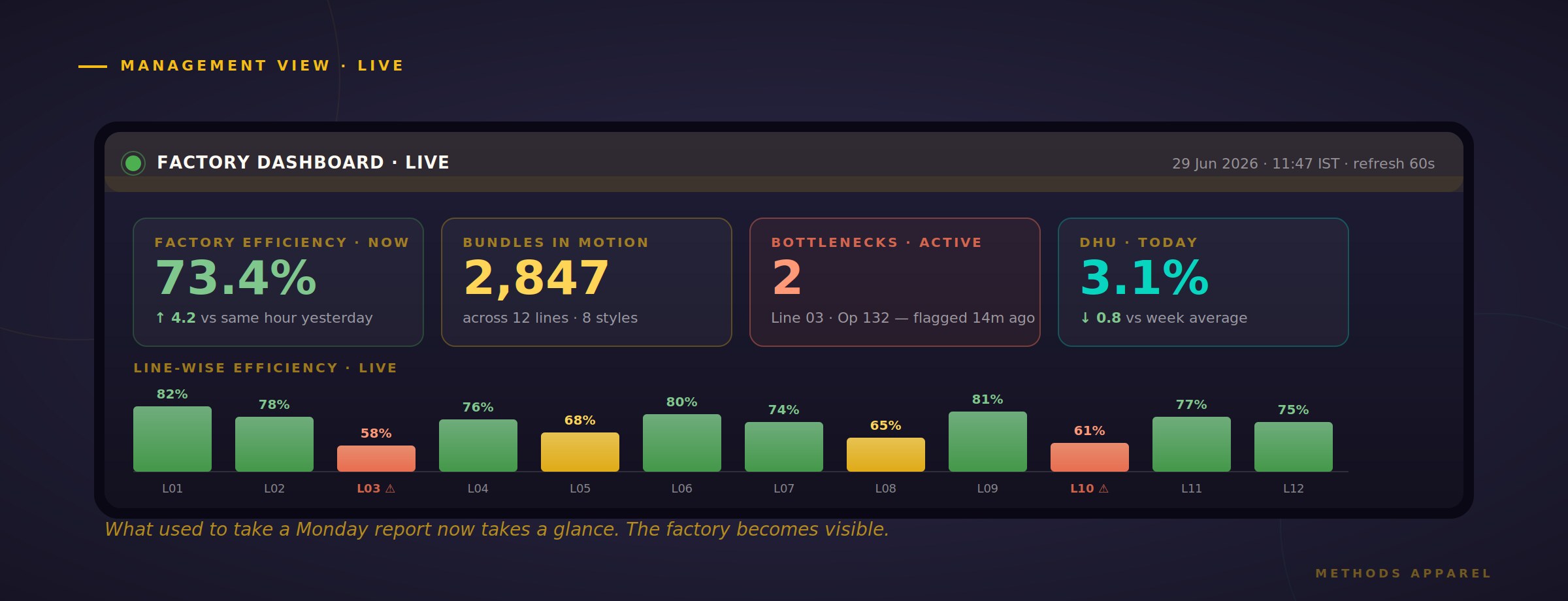
1. Real-time line efficiency. Not the end-of-shift number. The actual current minute. If a line is running at 67% right now, it shows on the screen right now — not Monday morning.
2. Bottleneck detection within hours. If Operator 089 has been running 30% below SMV for two hours, the system flags it. The IE knows. The supervisor knows. Action gets taken in hours, not days.
3. WIP visibility per section. Cutting WIP, Sewing WIP, Finishing WIP, Packing WIP — all live, refreshed every minute. Production planners can rebalance the floor in the morning based on the actual current bottleneck, not yesterday's.
4. Per-garment traceability. When a quality complaint comes from a buyer, the answer is in the system. Which operator stitched it. Which checker passed it. Which carton it shipped in. No reconstruction required.
5. Operator-level performance. Real efficiency per operator, per operation, per style. Not the averaged number on a wage slip — the actual hour-by-hour reality. Incentive schemes become defensible. Performance reviews become fair.
What Implementation Actually Requires
Implementing cut-to-pack QR tracking is not a software install. It is an operational change. The factories that do it well treat it that way. The ones that don't, struggle.
Three things determine success:
The hardware is straightforward — printers, scanners, tablets, displays. The software is mature. The piece that determines whether the system delivers full ROI is whether the floor culture adapts to scanning as a habit, not a chore. Factories that invest in that adaptation see full ROI in 4–6 months. Factories that just install and walk away see 30–40% of the potential value.
Why This Matters More Every Year
Five years ago, real-time tracking was a competitive advantage. Today it is becoming an entry requirement. Major buyers — Zara, H&M, Marks & Spencer, Target, Walmart, Levi's — are increasingly asking sourcing partners for live order visibility, full traceability per garment, and digital audit records. Factories that cannot provide these are being filtered out of the high-margin programs.
Within the next 2–3 years, paper-tracked factories will find it structurally harder to win premium business. Not because their quality is worse. Because their visibility is worse, and buyers can no longer afford sourcing partners they cannot see into.
The shift from paper register to QR-based tracking is no longer about productivity gain. It is about staying competitive for the orders that pay you the most.
How Pro-X 4.0 Operationalises This
Pro-X 4.0, our flagship cut-to-pack production tracking platform, was built for exactly this transition. It generates QR-coded bundle stickers at cutting, captures real-time scans at every floor station, integrates with Pro-SMV for accurate operator targets, feeds live dashboards to supervisors and management, and produces full per-garment traceability for buyer audits.
Beyond the technology, our team has spent 40+ years implementing operational change in apparel factories. The software is one piece. The other piece is the discipline shift on the floor — and that is where most software implementations either succeed or quietly fail. Pro-X 4.0 deployments come with on-the-ground implementation support designed to make the cultural shift stick.