Ask ten apparel factory owners what 5S is and eight will describe some version of "keeping the floor clean and organised". A few will add "the audit before a buyer visit". Almost none will describe it as a productivity intervention with quantifiable ROI.
Which is why 5S is the most consistently underestimated tool in a factory manager's arsenal. The framework has been around for 60 years. It requires almost no capital investment. It compounds across every operator on every shift. And it is one of the very few improvement programs where a factory can genuinely see the payback in a single quarter.
And yet — most factories that launch 5S abandon it by Month 4. Not because it didn't work. Because the wrong people measured the wrong thing and declared victory too early. In our 40+ years guiding factories through Lean implementation across South Asia, we have watched this specific arc play out enough times to write about it directly.
What 5S Actually Is (Beyond the Textbook)
The textbook framework — Sort, Set in order, Shine, Standardise, Sustain — is technically correct and practically useless. It tells you the letters without telling you what you are actually recovering. That gap between "what 5S looks like" and "what 5S produces" is where every failed program lives.
Here is the operational definition that matters: 5S is the systematic elimination of 30-second losses that each operator experiences 150-250 times per shift. The scissors that took 15 seconds to locate. The thread cone that wasn't at the workstation. The waste bin that was two steps too far. The label sheet stored on the wrong side of the workspace. Each one is trivial. Together they are the difference between a 75% efficient line and an 85% efficient line.
5S is not about the floor looking better. It is about the operator not spending 90 minutes a day looking for things, walking to fetch things, and working around things that shouldn't be where they are.
The Math Nobody Runs
Let us put concrete numbers to the compounding. A typical sewing operator experiences roughly 200 micro-friction events per 8-hour shift. Locate scissors. Fetch a bobbin. Adjust chair. Walk to the trim table. Move an obstruction. Untangle a thread cone. Each averages about 25-35 seconds, most of it recoverable.
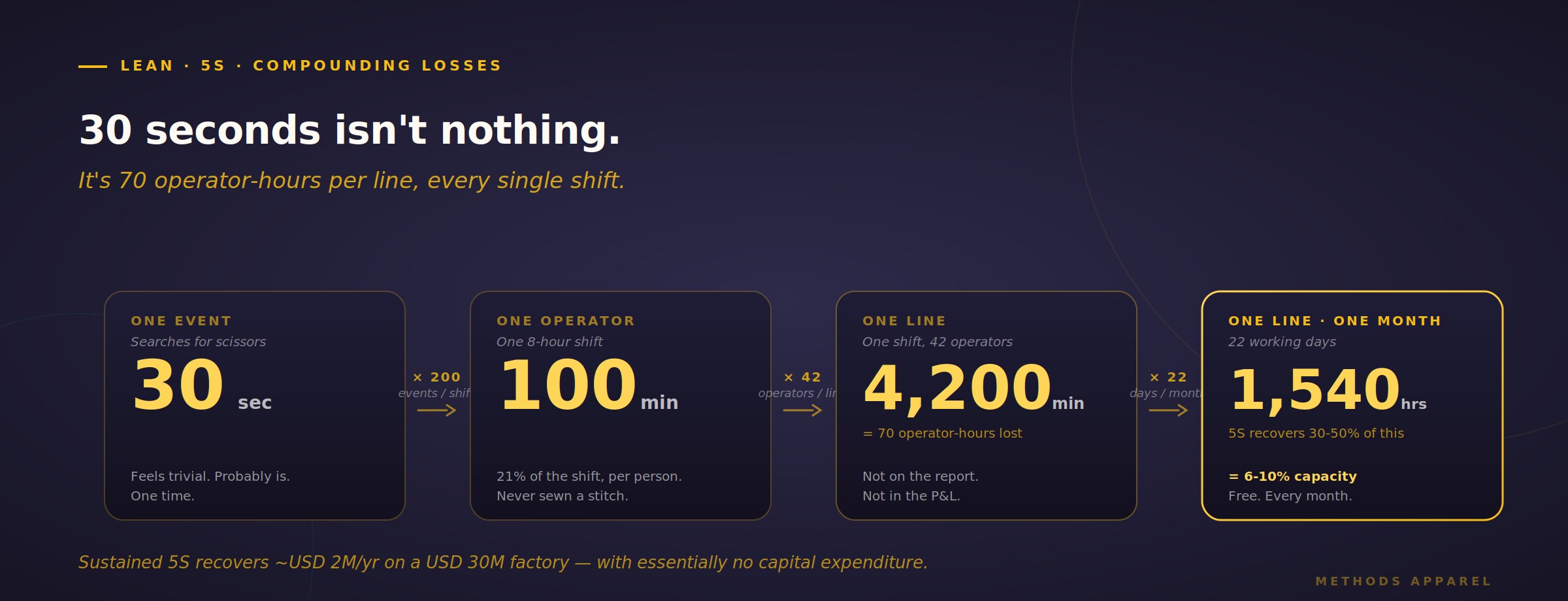
Do the arithmetic on one operator: 200 events × 30 seconds = 6,000 seconds = 100 minutes per operator per shift. Out of 480 minutes available, that is nearly 21% of the shift consumed by micro-friction that has nothing to do with actually sewing.
Now scale it across the line. 42 operators × 100 minutes = 4,200 minutes of hidden micro-loss per line per shift. That is 70 operator-hours. Across 22 working days in a month, that becomes 1,540 operator-hours per line per month. Multiply by 12 lines and it becomes a genuinely large number.
5S will not recover all of that. Realistically, a well-implemented and sustained 5S program recovers 30-50% of these micro-losses — the rest are structural to the process itself. But 30-50% of a 20% shift loss is 6-10% of shift capacity, recovered with essentially no capital expenditure.
The Five Micro-Losses That Actually Compound
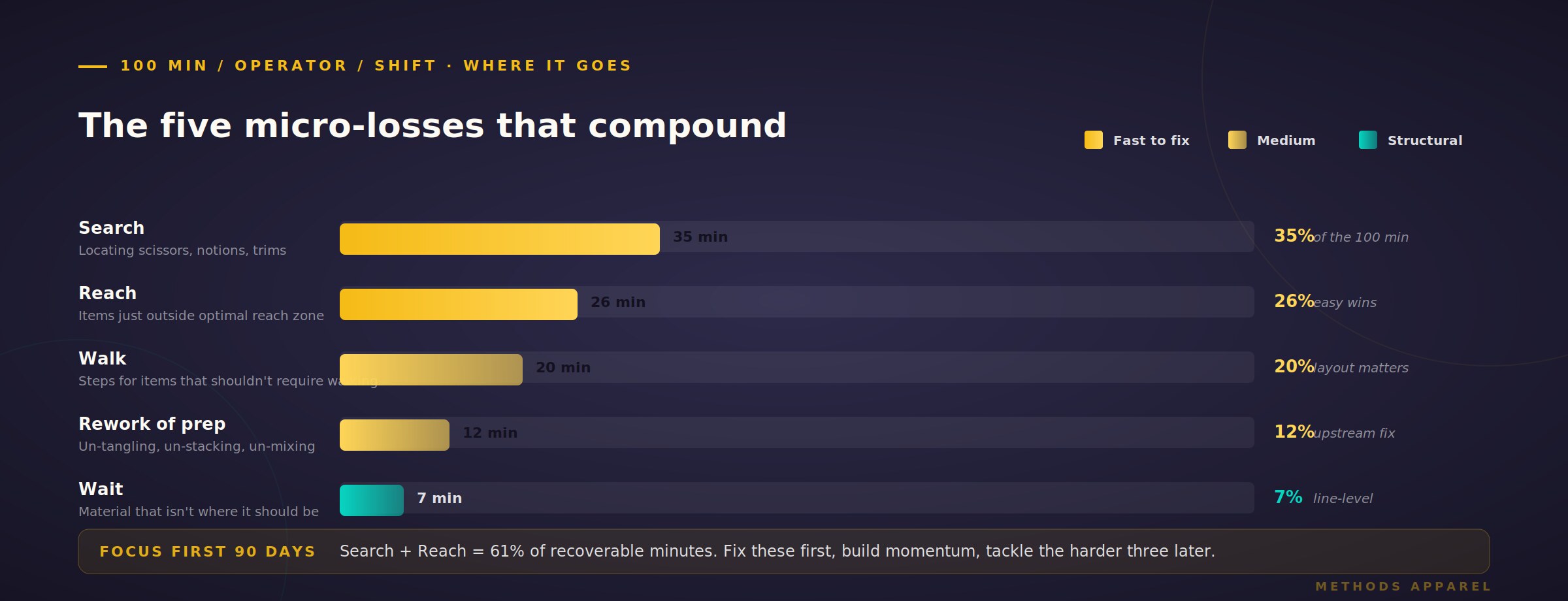
Not every 30-second event is a candidate for 5S. Some are structural (a genuinely required trim change). Some are stylistic (an operator who chooses to reorganise every time). The ones that compound — and that 5S is specifically designed to eliminate — fall into five categories that a floor walk can identify in an hour.
Each of the five compounds differently. Search and reach are the fastest to eliminate — a single workstation reorganisation often removes 40% of these within a week. Walk and rework take longer because they require line-layout thinking, not just workstation thinking. Wait is the hardest because it is usually an upstream problem showing up as a downstream symptom — 5S at the sewing station can't fix a bad kitting process.
The mistake most factories make is to treat all five equally in their 5S audit checklist. In practice, the first two are where 80% of the recoverable minutes live. Programs that focus there in the first 90 days see results faster and build the political capital needed to tackle the harder three.
Why 5S Programs Die at Month 4
A predictable arc plays out in most first-time 5S implementations. Month 1 is enthusiasm — visible changes on the floor, quantified early wins, leadership excitement. Month 2 sustains the pattern. Month 3 sees the first slow-down as harder problems replace the easy ones. Month 4 is when it quietly stops.
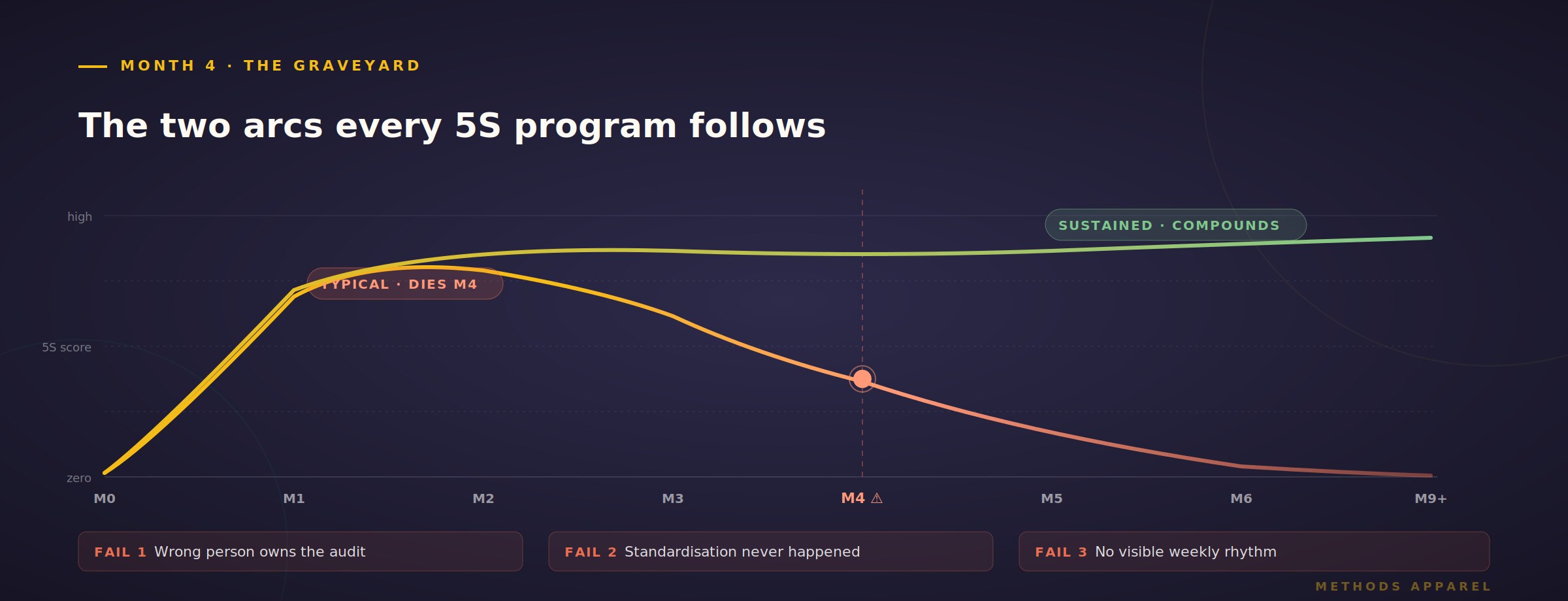
The reason is almost always the same and it has nothing to do with operator discipline. It has to do with three sustainability failures that leadership systematically misses.
Failure one — the wrong person owns the audit. If the 5S audit is owned by the person responsible for the floor's productivity, they will (rationally) score generously to avoid highlighting their own failures. The audit needs to be owned by a role that is independent of production — typically IE or an HR/EHS function that reports outside the factory manager's line.
Failure two — the standardisation step never actually happened. Everyone remembers the first three S's. Standardise is the one that dies quietly because it requires writing down what "good" looks like at each workstation, and updating that document as the process evolves. Most factories complete the standardisation document once, in Month 1, and never open it again. By Month 3 the standard is fictional.
Failure three — no visible weekly rhythm. Sustained 5S requires a weekly audit cadence with results posted where operators can see them. Not a monthly review with management. A weekly floor-level display. Without visible weekly rhythm, 5S becomes an invisible expectation, and invisible expectations get quietly deprioritised.
5S does not fail because operators forget. It fails because leadership stops paying visible attention. Sustainability is not a discipline problem — it is a management-visibility problem.
What Sustained 5S Looks Like
A factory that has moved past the Month-4 wall has a specific set of visible practices. None of them is expensive. All of them are missing in factories where 5S has quietly died.
| Practice | What It Looks Like |
|---|---|
| Weekly floor audit | 15-minute walk, same day each week, independent auditor, scored on a public sheet |
| Living standard document | Photo-based workstation standard, updated within 48 hrs of any layout change |
| Visible dashboard | Line-level 5S score posted where operators pass daily, updated within 24 hrs |
| Leadership gemba | Factory manager walks the floor with the 5S auditor once a week, minimum |
| Recognition rhythm | Best line recognised monthly; deteriorating lines get supervisor coaching, not blame |
| Operator-led improvement | Operators can raise 5S friction to their supervisor and see resolution within a week |
Notice what is not on this list: expensive tools, dedicated staff, complex software. Sustained 5S requires 15 minutes of leadership attention per week and the discipline to keep doing it after the novelty wears off. That is genuinely all.
The Gains Factories Actually See
Factories that push through the Month-4 wall and sustain 5S for a full year typically see three categories of measurable gain — not one.
Capacity recovery of 6-10% from micro-friction elimination. This is the direct productivity number, the one most people cite. On a USD 30M factory it is roughly USD 2 million of annual output.
DHU (defects per hundred units) reduction of 15-20% from visual controls that prevent mix-ups. Bins are colour-coded and located consistently, so wrong-size labels and wrong-shade thread rarely reach the operator. Nobody frames this as a 5S benefit, but it consistently shows up in the quality data.
Accident and near-miss reduction of 25-40% from clear walkways, tool control, and reduced clutter. This one is easy to overlook because incidents are already rare — but the reduction is real, and buyers auditing for social compliance notice.
Combined, these three represent one of the highest returns available on any factory improvement program. The reason they are not universally captured is that most 5S programs never make it to Month 6.
How Methods Approaches This
We treat 5S as the entry point to broader Lean implementation, not as a standalone cleaning exercise. Our approach starts with a one-week floor diagnostic — walking the floor with your team, quantifying the five micro-losses at real workstations, and producing a written baseline that becomes the starting point for the intervention.
From there, our consultancy engagement typically runs a structured 12-week 5S rollout followed by a 90-day sustainability review — the period in which most in-house programs quietly die. The sustainability review is where we invest most of the effort, because the sustainability practices above only work when someone independent is watching the pattern.
It is worth being direct about scope: 5S is not a Methods software product. It is a consultancy engagement. What we bring is 40+ years of watching which specific implementations survive Month 4 and which do not, and the operational discipline to help your team build the second kind.